Slava Novorossiya

Sunday, January 25, 2015

Thursday, January 22, 2015


10 REASONS WHY YOU SHOULD MARCH FOR LIFE [ARTICLE ON PRO LIFE]
To celebrate this
year’s March For Life 2015, I will present this
Pro-Life Article from Live Action, a Pro-Life Organization that I
endorsed:

INTERNET
SOURCE: http://liveactionnews.org/10-reasons-why-you-should-march-for-life/
10 reasons why you
should March for Life
3:15 pm, Jan 16, 2015
Every
life is a gift. That’s the message that the 2015 March
for Life is emphasizing for its 2015 event on January 22. The March for
Life is an annual event, held each year on the anniversary of Roe v. Wade. It was on
this day in 1973 that the U.S. Supreme Court found a Constitutional right
to abortion despite no mention in the Constitution.
Now,
57 million lives later, the pro-life movement shows no signs of slowing. The
March for Life began as a small event, but it quickly became the largest
peaceful pro-life demonstration in the nation.
Here
are 10 reasons to march for life (wherever you are):
1.
Because abortion is a silent holocaust, and marching draws attention to the
atrocities.
There is power and strength in numbers. The old saying declares that “the
squeaky wheel gets the grease.” When we are silent about abortion, abortion can
more easily continue unchallenged. Make noise.
2.
Because of the
connections and unity you will find. You will join like-minded
people, make friends you can partner with in the fight for life, and connect
and encourage your own heart to continue the battle for life.
3. Because the nation is dying.
Literally. Recently this story reminded us what 57 million people killed looks
like. It looks like a nation that is dying en
masse.

4.
Because a true feminist
attitude is a pro-life attitude. It’s a lie that women are
empowered by having a right to kill their offspring. A real woman protects her
young — whether by raising her child or by letting another adopt her child. The
strong woman supports life, and women in this nation need to see you stand up
for them — not timidly, but with the strength to fight for life. We need to
counteract the militant voices that proclaim that feminism means a right to
kill.
5. Because justice matters.
It’s been impossible to follow the news in the past few months without hearing
a reminder of the need for justice, especially for African-Americans. Abortion
is not at all different. According to the pro-abortion think-tank the Guttmacher
Institute, “black women are more than 5 times as likely as white women to have
an abortion.” If we are fighting for justice, especially in a time of racial
tension, it’s negligent not to fight for justice for these African-American
babies, who are dying at a higher rate.
6. Because the old song and cliché are
correct: children are the future. It sounds like a sappy
greeting card, and yet when we stop and think about it, what future do we have
when babies are killed at will? None. The next abortion actually could be the
child who grows up to cure cancer, save your child’s life in an accident, solve
the problems that plague us, or maybe simply marry the baby you have yet to
have. Every abortion steals a chance for hope. We march to cry for hope for our
future.
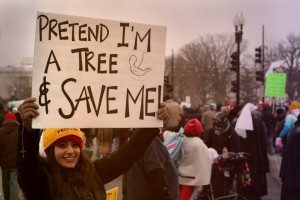
7.
Because of the civil
rights movement. As we celebrate Martin Luther King, Jr. and
his influence on civil rights in the same week as we grieve the anniversary of
legalized abortion, we must remember that abortion is a civil rights issue.
Though the Declaration of Independence says that “all men are created
equal, that they are endowed by their Creator with certain unalienable Rights,
that among these are Life, Liberty and the pursuit of Happiness,” there’s a
silent disclaimer that the abortion industry makes: if we let you be born. All lives deserve the
same rights.
8.
Because for every 1,000
babies born, 228 are killed by abortion. That makes it about 19%; 1 out of 5 babies never get to live. We march to fight
for their right to live, to bring awareness to this terrifying data, and to put
passion and action behind the outrage. We march to call for life for all five
of those babies, recognizing that four out of five is not sufficient.

9.
Because you can march
for life where you are. Not everyone can get to Washington,
D.C. each year, but all over the nation, cities and regions hold their own
March for Life events in support of the national event and to amplify their
voice in their region. To add your name to this list and join a march near you,
you can look at this link.
10.
Because every life is
really a gift, as this year’s March for Life theme says. But
those who have a prenatal diagnosis of Down syndrome, Trisomy 18, Trisomy 13,
spina bifida, etc., have only about a 10% chance of being born. While those who
are allowed to live are repeatedly noted as being some of the most loving and
wonderful people to those who know them, the fear of simply carrying one of
these pregnancies to term is so great that it’s rare that it happens.
So
many reasons exist to march for life. The March for Life group has social media
campaign going right now to show the many reasons people cite. Have
a look here, join in where you are — and whatever you do, march for life!
5 THINGS YOU DIDN’T KNOW ABOUT ROE V WADE [ARTICLE ON PRO LIFE]
To
celebrate this year’s March For Life 2015, I
will present this Pro-Life Article from Live Action, a Pro-Life Organization that I
endorsed:
INTERNET
SOURCE: http://liveactionnews.org/5-things-you-didnt-know-about-roe-v-wade/
5 things you didn’t know
about Roe v Wade
8:32 am, Jan 16, 2015

As
one of the most famous cases in United States history, Roe v Wade is perhaps one
of the least understood. The decision, in conjunction with Doe v Bolton, underscored
abortion as a constitutional right and gave the green light to
abortion-on-demand across the country. As a result, the U.S. Supreme Court
single-handily sanctioned the killing of 57 million preborn children through
abortions decades following the decision on January 22, 1973. On the 42nd
anniversary of the ruling, Roe’s impact – though weakening through a growing
pro-life movement – lives on.
1. “Jane Roe” of Roe v Wade is now
pro-life

The
woman behind the U.S. Supreme Court ruling that catapulted abortion-on-demand
in the United States never had an abortion. In fact, in the 1970s, Norma McCorvey
was seeking a divorce from her husband and sought a legal abortion when she
faced an unplanned pregnancy; however, pro-abortion attorney Sarah Weddington
used McCorvey’s case to overturn a Texas abortion prohibition. McCorvey, who is
now a pro-life advocate, has since dedicated her entire life to overturning the
law that bears her name.
“Back
in 1973, I was a very confused 21-year-old with one child and facing an
unplanned pregnancy,” McCorvey said. “I think it’s safe to say that the entire
abortion industry is based on a lie…. I am dedicated to spending the rest of my
life undoing the law that bears my name. You read about me in history books,
but now I am dedicated to spreading the truth about preserving the dignity of
all human life from natural conception to natural death.”
2. Roe and Doe permit abortions up to birth

Roe v Wade
and its companion case, Doe
v Bolton, rendered abortion permissible in the United States up to
nine months of pregnancy. In Roe,
the U.S. Supreme Court sanctioned abortions at roughly seven months, or prior
to the “viability” of a preborn child. In Doe,
the high court ruled that abortions can occur after the child is viable in
cases of a “health exception,” permitting a mother to abort her child.
Essentially,
abortionists can single-handily define what constitutes a “health risk.”
The definition is so broad that a woman can obtain an abortion for virtually
any reason. The Supreme Court, in justifying reasons to kill a child through an
abortion procedure, widened the term “health” to include “physical, emotional,
psychological, familial, and the woman’s age –relevant to the well-being of the
patient.”
3. Contrary to Roe, there is no fundamental “right” to
an abortion in the Constitution

Contrary
to what justices ruled in Roe
v Wade, the “right” to an abortion does not exist in the U.S.
Constitution. The court’s broad reading of the Constitution, based on the
concept of living constitutionalism, allowed justices to define a right not
found in the text or the original intent of the Constitution. Invoking the Due
Process Clause of the Fourteenth Amendment, justices decided that a restriction
on abortion violates the right to privacy.
Justice
Blackmun wrote in the opinion for the landmark Supreme Court ruling, “This
right of privacy … founded in the Fourteenth Amendment’s concept of personal
liberty and restrictions upon state action … is broad enough to encompass a
woman’s decision whether or not to terminate her pregnancy.” However, Edward
Lazarus, former clerk to Justice Blackmun contested: “A constitutional right
to privacy broad enough to include abortion has no meaningful foundation in
constitutional text, history, or precedent.” Tragically, the Due Process
Clause is now being used as a means for judicial activism instead of protecting
citizens from deprivation of life, liberty, or property without a fair process,
as it was intended.
4. Support for abortion before Roe was decided was fabricated

The
late Dr. Bernard Nathanson, former abortionist and co-founder of the
pro-abortion group NARAL, admitted that the number of women dying from
back-alley and self-inflicted abortions was completely fabricated prior to the Roe v Wade decision.
Abortion proponents claimed that a million women were obtaining illegal
abortions in the United States each year, and 5,000 to 10,000 women were dying
as a result of back-alley abortions. However, as Nathanson said, the numbers
were highly exaggerated to sway public opinion.
Nathanson
wrote: “I confess that I knew the figures were totally false, and I suppose the
others did too if they stopped to think of it. But in the ‘morality’ of our
revolution, it was a useful figure, widely accepted, so why go out of our way
to correct it with honest statistics? The overriding concern was to get
the laws eliminated [laws against abortion], and anything within reason that
had to be done was permissible.”
The
idea that abortion is a necessary components of women’s health is still
engrained in public perception. What the media fail to mention are the
countless women who have died as a result of botched abortions, and the many
more who are emotionally and physically scarred from an abortion procedure.
While many deaths by abortion are covered up – fatalities labeled as
hemorrhaging or death by natural causes – pro-abortion backers push abortion as
a safe procedure with little risks.
5. After Roe, abortions peaked

In
the years following the landmark decision, the number of abortions rose
drastically, reaching a zenith of 1.6 million abortions in1990 before the
number gradually started to decline. Under the Roe v Wade decision and its counterpart, the
lives of 57 million preborn children in the United States have been violently
ended by abortion. The injustice of abortion is the nation’s greatest human
rights abuse, taking the lives of over 1 million each year.
HAPPY 54TH BIRTHDAY, ALVEDA KING [PRO LIFE QUOTE]
 |
| Alveda King |
 |
|
|
Abortion and racism are both symptoms of a fundamental human error. The error is thinking that when someone stands in the way of our wants, we can justify getting that person out of our lives. Abortion and racism stem from the same poisonous root, selfishness.- Alveda King
AUTHOR: Dr. Alveda C. King works toward her
purpose in life, to glorify God.
Dr. King currently serves as a Pastoral Associate and Director of African-American Outreach for Priests for Life and Gospel of Life Ministries. She is also a voice for the Silent No More Awareness Campaign, sharing her testimony of two abortions, God’s forgiveness, and healing.
The daughter of the late civil rights activist Rev. A.D. King and his wife Naomi Barber King, Alveda grew up in the civil rights movement led by her uncle, Dr. Martin Luther King, Jr. Her family home in Birmingham, Alabama, was bombed, as was her father’s church office in Louisville, Kentucky. Alveda was jailed during the open housing movement. She sees the prolife movement as a continuation of the civil rights struggle.
Dr.
King is a former college professor and served in the Georgia State House of
Representatives. She is a recipient of the Life Prize Award (2011), the
Cardinal John O’Connor Pro-Life Hall of Fame Award (2011) from the Legatus
organization and the Civil Rights Award from Congress of Racial Equality (CORE)
(2011). She is a bestselling author; among her books are King Rules:
Ten Truths for You, Your Family, and Our Nation to Prosper, How Can
the Dream Survive if we Murder the Children? and I
Don’t Want Your Man, I Want My Own. She is an accomplished actress
and songwriter. The Founder of Alveda King Ministries, Alveda is also the
recipient of an honorary Doctorate of Laws degree from Saint Anselm
College. She has served on several boards, including Heartbeat
International, Georgia Right to Life, MLK Center, Bible Curriculum in Public
Schools and Abortion Recovery International (ARIN). She is also a member of the
National Black Prolife Coalition (NBPC) and is a Senior Fellow with the Howard
Center for Family, Religion & Society. Alveda is a regular columnist for
Newsmax.com “Insiders” section.
Dr.
King lives in Atlanta, where she is the grateful mother of six and a doting
grandmother.
 |
|
Alveda King Protest against Planned
Parenthood
|
Subscribe to:
Posts (Atom)